
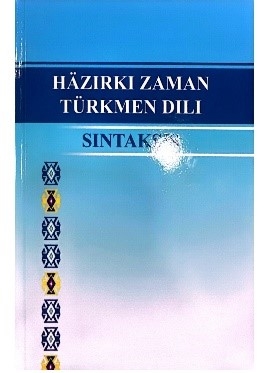
Practical textbook on the syntax of the modern Turkmen language
In the Epoch of the Revival of the New Era of the Powerful State, as a result of the wise policy of our Esteemed President, decrees and laws adopted in the field of education and science have further expanded the scale of public functions of the Turkmen language, which has the status of the state language. In the full sense of the word, it has become an important tool for science and education, upbringing, the press, government and the development of consciousness.
In accordance with the tasks set by our Esteemed President to provide the younger generation with high-quality education and bring the level of education in line with world standards, regular work is currently being carried out to provide secondary schools, secondary vocational and higher educational institutions with textbooks and manuals, which is considered one of the most urgent tasks of the domestic education system.
In different years, fundamental scientific works, textbooks and manuals were written on phonetics, lexicology, word formation, morphology, syntax and stylistics of the Turkmen language. Such works on syntax as “Modern Turkmen language. Syntax” (1962), “Problems of morphology and syntax of the Turkmen language” (Hamzayev M., 1969), “Structure of a complex sentence in the modern Turkmen language. Complex sentence” (Nartiyev N., 1981), “Modern Turkmen language. Syntax” (Nartiyev N., Pendjiyev M., Myradov A., 2002) were carried out. These textbooks and manuals are widely used by Turkmen linguists, teachers of secondary schools, secondary vocational and higher educational institutions. Almost all of these publications present conclusions on theoretical issues of different sections of the language. Obviously, practical textbooks on each of these sections are necessary in the teaching methodology.
In the practical textbook "Modern Turkmen Language. Syntax", which was prepared by the senior lecturer of the Turkmen Language Department of Dovletmammet Azadi Turkmen National Institute of World Languages, candidate of philological sciences Gurbangul Myradova and lecturer of the Language Department of the Institute of Telecommunications and Informatics of Turkmenistan Aknur Meredova, and published by the Turkmen State Publishing Service, special attention is paid to the practical side of syntax issues. Brief information about its theoretical basis is also given. They are supported by texts, exercises and tasks. It provides training in spelling and punctuation rules, spelling norms for each topic.
The textbook examines the issues studied by syntax: syntactic units, syntactic means, syntactic relations, syntactic connections, phrases, sentences, texts, reported speech, quotations, conversations, the connection of syntax with other sections of linguistics, in particular, with punctuation.
This textbook is prepared for teachers and students of higher educational institutions.
Dovletmammet Azadi Turkmen National Institute of World Languages