
of the Innovation Information Center
of the Ministry of Education of Turkmenistan
of the Innovation Information Center
of the Ministry of Education of Turkmenistan
Independent Neutral Turkmenistan - the
homeland of purposeful winged horses



News
Representatives of Turkmenistan’s Education System Participate in Training Programs Organized Within the Framework of the U.S. State Department’s “International Visitor Leadership Program” (IVLP)
255
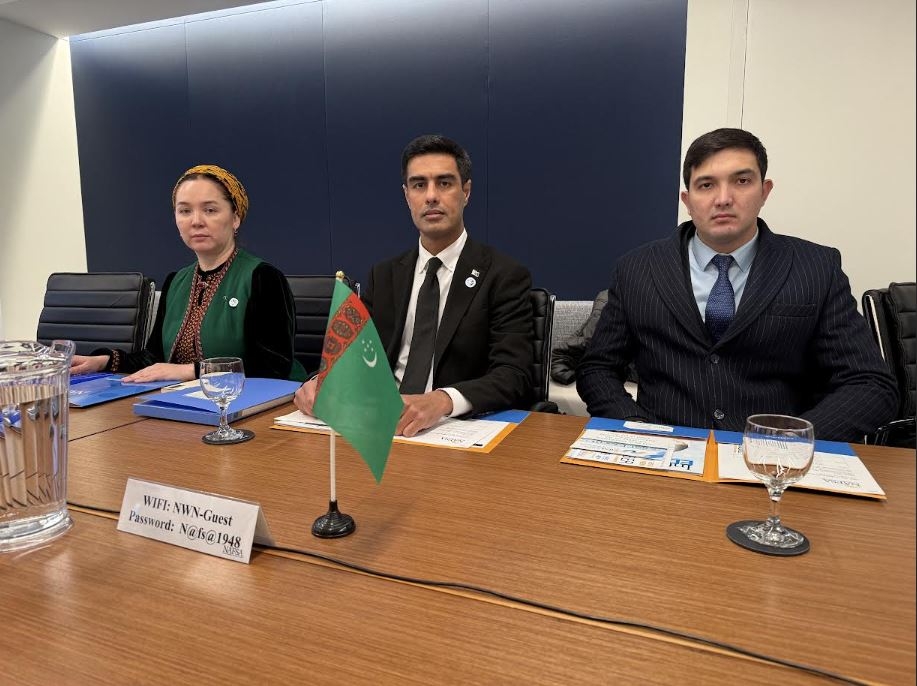
As previously reported, representatives from Magtymguly Turkmen State University, the International University for the Humanities and Development, the Turkmen Institute of Telecommunications and Informatics, and the National Institute of Education of Turkmenistan are on a working visit to the United States to participate in the training program “Managing Higher Education Institutions: Cooperation and Commercialization”, organized within the framework of the U.S. State Department’s International Visitor Leadership Program (IVLP).
As part of the visit, training sessions were held for the Turkmen delegation at the U.S. National Institutes of Health (NIH). The American side was represented by Professor Karl Western, Ms. Stephanie Fertig, and Dr. Andrea Wurster.
The National Institutes of Health (NIH) is one of the leading research centers in healthcare, conducting and supporting scientific studies to understand diseases, improve treatments, and enhance healthcare systems. NIH comprises 24 centers, each specializing in a specific scientific field. For example:
• The National Cancer Institute (NCI) focuses on studying and combating cancer-related diseases.
• The National Heart, Lung, and Blood Institute (NHLBI) conducts research on cardiovascular and pulmonary diseases.
• The National Institute of Mental Health (NIMH) addresses mental disorders and their treatment.
The institute conducts its research in collaboration with universities and healthcare institutions. NIH plays a crucial role globally in developing new medications, diagnostic methods, and preventive measures for various diseases.
To promote innovation in healthcare, NIH actively collaborates with entrepreneurs, industry regulatory bodies, and the private sector through various initiatives and programs. This collaboration accelerates the transition of scientific discoveries into practical treatments and products.
NIH also maintains active relationships with private companies and investors to conduct joint research and develop new products. The institute successfully utilizes technology transfer mechanisms that significantly aid in commercializing scientific discoveries. Through these processes, entrepreneurs and private companies sign licensing agreements with NIH to develop new medications, medical devices, or diagnostic methods and to use patents and scientific research in this field. Specialized centers like the NIH Office of Technology Transfer (OTT) handle licensing technologies within the institute.
Additionally, NIH offers various training programs and mentorship initiatives to help entrepreneurs develop their ideas and overcome obstacles in commercializing scientific results. These programs assist entrepreneurs in understanding how to transform a scientific discovery into a successful product for the market.
The efforts of the National Institutes of Health in implementing these initiatives contribute to the rapid development of medical innovations and ensure sustainable growth in biotechnology, pharmaceuticals, and medical sectors.
The Turkmen delegation also held a discussion with Ms. Cori Crisfield and Ms. Sylvia Jones, representatives of the International Cooperation Center of the U.S. Institute of International Education.
The International Cooperation Center of the U.S. Institute of International Education is a renowned organization dedicated to fostering and developing international academic and professional relations through exchange and cooperation programs. Its main areas of activity include:
1. Establishing international partnerships among students, faculty, and researchers from educational institutions worldwide and supporting exchange programs.
2. Developing and managing programs that promote educational and cultural mobility.
3. Conducting scientific research in the international education system and supporting the exchange of information among partner countries.
4. Assisting higher education institutions in creating sustainable international relations and cooperation strategies.
During her speech, Ms. Cori Crisfield highlighted the center’s active cooperation with over 30 countries, including Kazakhstan, within the framework of academic exchange and international cooperation programs. She expressed readiness to establish similar collaborations with Turkmenistan.
The Turkmen delegation’s meeting with Mr. David Edelstein, Vice Provost for Academic Affairs at Georgetown University, was particularly impactful.
Georgetown University, located in Washington, D.C., is a private higher education institution primarily engaged in scientific research. Established in 1789, it is one of the oldest and most prestigious universities in the world. The university is renowned for its academic excellence and high-quality educational programs in international relations, law, business, medicine, and the humanities. Currently, approximately 19,000 students are enrolled in undergraduate and graduate programs at Georgetown University. It consistently ranks among the top 20 prestigious higher education institutions in the United States and leads globally in international relations programs. Georgetown University maintains international partnerships with higher education institutions in Germany, the United Kingdom, France, the People’s Republic of China, South Korea, and other countries.
The university’s only branch campus, Georgetown University in Qatar, is located in Doha, Qatar. Established at the request of the Qatari government, it provides undergraduate programs in accordance with Georgetown University’s academic standards, awarding degrees equivalent to those of its main campus.