
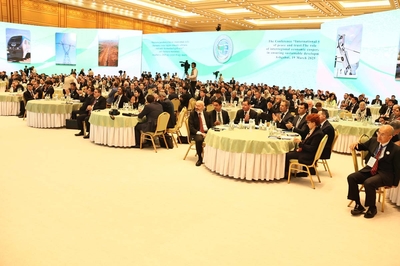
An International Conference on the Topic: "International Year of Peace and Trust: The Role of Interregional Economic Cooperation in Ensuring Sustainable Development" Was Held
Dear Conference Participants!
I express my gratitude for your participation in this forum and wish you successful work!
Representatives of foreign states, international organizations, and major companies have gathered here, demonstrating significant interest in partnering with our country.
Turkmenistan directly links the concept of peace and trust with economic development. In this context, the current year—the "International Year of Peace and Trust"—should provide a powerful impetus to economic cooperation.
I am confident that peace, trust, equality, and mutual benefit should form the foundation of economic partnerships. Any large-scale economic, infrastructure, trade, and investment projects can succeed only under conditions of equality and mutual trust.
Dear Conference Participants!
In the modern era, regional and interregional relations are strengthening in various parts of the world, and new economic alliances are emerging. We have entered an era of rapid economic progress based on the use of geographical resources, modern technologies, environmental standards, and efficient solutions.
Today, it is necessary to think globally, act, and cooperate accordingly. In this regard, leading international institutions and financial organizations bear a special responsibility.
Turkmenistan consistently advocates for a fair geoeconomic order. By diversifying energy resources, transport corridors, and existing infrastructure systems, our country supports the implementation of major new economic projects. A prime example of this is economic cooperation between Central and South Asia.
I would like to draw your attention to the geopolitical and geoeconomic significance of the energy, transport, and infrastructure projects being implemented in these regions. They aim to connect Central and South Asia by creating new energy, transport, industrial, and technological corridors.
The Turkmenistan–Afghanistan–Pakistan–India (TAPI) Gas Pipeline is one of the significant projects. The goal of this project is to provide natural gas to countries with a total population of 1.75 billion people in the modern era.
Today, we can confidently state that work on this project is progressing according to a well-defined plan. A 214-kilometer section of this gas pipeline has already been constructed within our country. In September of last year, construction began on a 153-kilometer section from Serhetabat to Herat, known as "Arkadagyň ak ýoly". Currently, construction continues in Afghanistan.
Dear Conference Participants!
Speaking about the TAPI gas pipeline project, I would like to emphasize its high social significance. According to expert assessments, the construction of the pipeline, along with associated infrastructure systems, new institutions, and enterprises, will create 12,000 jobs in Afghanistan and address several key humanitarian issues in the country.
The project's implementation involves resolving numerous legal, commercial, and financial matters. The activities in the oil and gas sector within the framework of the Turkmenistan–Afghanistan–Pakistan–India Gas Pipeline project must comply with the internationally established norms and standards.
I am confident that this conference will enable leaders, specialists, and experts from energy companies, consulting firms, and banks to exchange views on joint activities within the framework of the Turkmenistan–Afghanistan–Pakistan–India Gas Pipeline.
Dear Conference Participants!
For several years, Central Asian states have been effectively cooperating with border regions in electricity supply. Expanding collaboration in this field, our countries are also proposing the construction of modern power facilities, which will facilitate the export of energy resources from Central Asia to global markets, including South Asia and the Asia-Pacific region—one of the priority directions.
Turkmenistan is one of the leading electricity-producing countries. For many years, we have been supplying electricity to neighboring countries, including Iran, Afghanistan, Uzbekistan, and Kyrgyzstan.
Our country, together with its partners, is also effectively working on implementing the high-voltage power transmission line project Turkmenistan–Afghanistan–Pakistan.
Currently, electricity is already being supplied to the city of Herat, Afghanistan. Work is also underway on technical documentation to extend this line through Afghanistan to Pakistan.
At the same time, a fiber-optic communication line is being laid as part of the project. Today, the transport connectivity between Central and South Asia, along with related development projects, is a key component of the economic strategies of the Eurasian continent.
In this context, I would like to emphasize the necessity of effectively utilizing existing transport and transit corridors linking Central and South Asia, as well as creating new ones. This will ensure comprehensive passenger and freight transportation along the North-South and East-West routes.
To expand these corridors, projects for the construction of railways and highways are being implemented. Modern infrastructure systems for air, sea ports, and dry ports are being developed. Large-scale work is being carried out to streamline and coordinate logistics processes.
An example of this is the railway construction from Turkmenistan to Afghanistan and further to Pakistan's ports. Currently, the 115-kilometer railway line Kerki (Turkmenistan) – Andkhoy (Afghanistan), built by Turkmen specialists, is operating efficiently. Additionally, discussions are ongoing regarding the construction of a 165-kilometer railway from the Turkmen-Afghan border to Herat.
A key role in this work is assigned to cooperation with the stakeholders involved in project implementation—international financial institutions, investment funds, banking institutions, and specialized organizations.
I am confident that our long-standing and reliable financial partners, such as the World Bank, Asian Development Bank, Islamic Development Bank, European Bank for Reconstruction and Development, and development funds and banks from Saudi Arabia, the UAE, Qatar, and other friendly nations, will continue their efforts to strengthen economic cooperation with Central and South Asia.
This forum serves as a great opportunity for financial sector representatives to present relevant proposals.
Dear Conference Participants!
Our common goals in Asia are not limited to the implementation of specific projects. Their scope is much broader. It is essential to establish a foundation for lasting peace and security in this part of the world, fostering an atmosphere of trust and creating a favorable environment for broad cooperation. To achieve this, we must utilize all available opportunities and establish one of the most promising global centers for energy, transport, and communication cooperation.
Turkmenistan has high hopes for the involvement of major international investors in achieving these goals. Our country, adhering to its policy of permanent neutrality and an "open-door" economic strategy, is open to productive cooperation.
I am confident that this conference will mark an important step in the realization of these plans.
I wish all participants of the conference fruitful work!
(Ashgabat, March 19, 2025)
Source: State News Agency of Turkmenistan