
Universities and Startups as Drivers of the Knowledge Economy in Turkmenistan
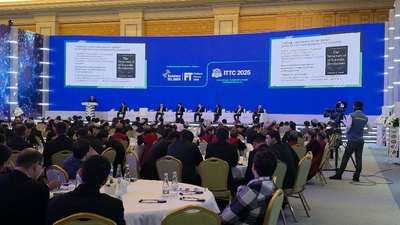
The session was moderated by Azat Seyitmuhammedov, Founder and CEO of Wabrum.com. The speakers included Deputy Minister of Education of Turkmenistan Azat Atayev, heads of IT parks and technology parks from Central Asian countries, representatives of the innovative Innopolis University (Russian Federation), a private startup accelerator, and the Union of Economists of Turkmenistan.
The Knowledge Economy as Turkmenistan’s Strategic Choice
Participants of the discussion stressed that at the core of Turkmenistan’s long-term National Programme for Socio-Economic Development for 2022–2052 is the transition to a knowledge economy and sustainable growth based on human capital, science, and innovation. The Programme itself assigns special importance to education, science, and innovation as key drivers of development.
It was noted that the global structure of business value has radically changed over the past decades: while 40 years ago up to 80% of leading companies’ assets were material resources, today up to 90% are intangible assets—intellectual property, software, algorithms, brands. The world’s top companies demonstrate labour productivity many times higher than the global average precisely due to technologies and knowledge.
It was particularly emphasized that, under these conditions, it is strategically important for Turkmenistan to integrate in a timely manner into the new technological paradigm—through the development of its own competences, science, engineering schools, and university-based innovation ecosystems.

Demographic “Window of Opportunity” and Human Resources for the New Economy
A separate part of the discussion was devoted to the demographic situation. Turkmenistan has one of the youngest populations, with an average age of 26.9 years.
Experts noted that this creates a rare “demographic window of opportunity” for the coming decades: provided that access to higher and secondary vocational education expands to the target levels, growth in labour productivity can make an additional contribution to economic growth in the near future.
In this regard, the importance of systemic work on forecasting future skills and professions was discussed: participants spoke about the need to “retrain the economy in advance” so that young people enter the labour market with the competences of tomorrow, not yesterday.
Atlas of Future Professions and National Foresight
An important element of the session was the exchange of experience on foresight studies and forecasting labour market needs. It was noted that, over the past two years, Turkmenistan has carried out substantial work on national foresight and, for the first time, has developed the Atlas of Future Professions of Turkmenistan.
This document includes 158 promising professions and specialities across 11 sectors of the economy—from the agro-industrial complex to IT and telecom, energy, and medicine. The Atlas is based on methodologies from international projects on future professions, adapted to Turkmenistan’s realities: foresight groups operated in universities with the participation of faculty, young researchers, employers, and students.
Participants of the session stressed that the Atlas should become a practical tool for:
- guiding schoolchildren and students in their choice of profession;
- updating educational programmes of higher and secondary vocational institutions;
- aligning employment policy and education policy over the long term.
Universities as the Core of the Innovation Ecosystem
A large part of the discussion focused on the role of universities in shaping the knowledge economy. Drawing on international statistics, it was noted that leading universities of the world—such as MIT and Stanford—not only are scientific leaders, but also create powerful innovation clusters around themselves: tens of thousands of companies, millions of jobs, and trillions of dollars in combined revenue.
Speakers emphasized that the universities of the future are not only places where knowledge is transmitted, but also “startup factories” where education, scientific research, and entrepreneurship are integrated into a single ecosystem.
The model of a university innovation ecosystem was discussed in detail:
- generation of ideas in laboratories and at student hackathons;
- support of proof of concept in incubators;
- development of prototypes in technology parks and prototyping centres;
- attraction of investment through accelerators, demo days, and investor clubs;
- market entry with the support of technology transfer centres (patents, licensing, search for industrial partners).
Participants agreed that the existence of such a “built-in” chain within a university sharply increases the chances that student and research projects will become sustainable businesses and, ultimately, strengthens universities’ impact on national economic development.
Incubators, Accelerators, and Regional Experience
Representatives of IT Park Uzbekistan and the High Technology Park of the Kyrgyz Republic shared their experience in creating national technology parks and IT parks, frameworks for residents, tax and infrastructural support measures for startups, as well as youth engagement tools—from hackathons and acceleration programmes to mentorship schemes.
The representative of Innopolis spoke about the model of a university city, where educational, scientific, and entrepreneurial environments are originally designed as a single innovation ecosystem, and about the importance of strong engineering education and digital skills for forming next-generation technology companies.
eGa Academy (Estonia) highlighted the importance of digital skills and e-governance: it was discussed how Estonia’s experience in building a digital state and developing e-services can be used when designing educational programmes and in the work of incubators focusing on GovTech solutions.
Representatives of a private startup accelerator and the Union of Economists of Turkmenistan raised issues of access to finance, development of private venture capital, the role of the business community and experts in project evaluation, and the need for a regulatory environment favourable to young companies.
A special emphasis was placed on supporting youth and women’s entrepreneurship: participants discussed targeted programmes for girls in STEM fields, formats of inclusive accelerators, and the role of universities in reducing barriers for women’s participation in technology business.
Regulatory Framework, KPIs, and Pilot Universities
In practical terms, experts discussed which elements of the legal and institutional environment are necessary for sustainable development of technology parks and startup ecosystems at universities. Among the key issues were:
- legal status of university technology parks and IT parks;
- regimes and incentives for residents;
- allocation of rights to intellectual property between the university, researchers, and investors;
- mechanisms of public procurement and funding of R&D through universities and their small innovative enterprises;
- integration of innovation performance indicators into the system of university performance evaluation (KPIs).
Participants noted that Turkmenistan has already introduced an updated national ranking of universities with 6 sections and 53 indicators that include publication and patent activity, income from R&D, participation in international projects, and more. This creates strong incentives for universities to enhance their research and innovation activities.
AI Challenges and the Transformation of Professions
Within the context of the session’s theme, considerable attention was given to the impact of artificial intelligence on the labour market. According to experts, the professions most at risk are those linked to routine information work: accountants, certain legal and administrative functions, traditional office jobs, as well as a number of logistics and service occupations.
At the same time, it was stressed that technologies will not completely replace humans: demand will grow for creativity, critical and systems thinking, communication, and entrepreneurial skills. The task for the education system and incubators is to reorient skills training towards these competences, harnessing the potential of youth and the time window provided by the demographic dividend.
Outcomes of the Session
In the final part of the discussion, participants agreed that:
- the transition to a knowledge economy is a strategic and non-alternative choice for countries seeking sustainable growth;
- the young population of Turkmenistan, under the right educational and innovation policies, can become a key resource for long-term development;
- universities must become centres of innovation, where teaching, research, entrepreneurship, and startup support infrastructure are integrated;
- successful development of incubators and accelerators requires a well-designed regulatory framework, new KPIs for universities, and active participation of the private sector;
- international cooperation and exchange of experience with IT parks, universities, and accelerators in other countries are essential for rapid and high-quality adjustment of the national ecosystem.
The conference concluded with a closing ceremony, at which the Minister of Communications of Turkmenistan, Hajymyrat Hudaygulyyev, delivered an address.
Participants of the session expressed deep gratitude to the National Leader of the Turkmen people and the esteemed President of Turkmenistan for the attention devoted to education, digital transformation, and support for youth initiatives. It was noted that firm political will, systemic support for universities and innovation structures, as well as encouragement of international cooperation make it possible to successfully implement the tasks set and open new horizons for further development of the sector.
Ministry of Education of Turkmenistan