



of the Innovation Information Center
of the Ministry of Education of Turkmenistan
of the Innovation Information Center
of the Ministry of Education of Turkmenistan
Independent Neutral Turkmenistan - the
homeland of purposeful winged horses
News
Enhancing Practical Cooperation in the Field of Education between Turkmenistan and the United Kingdom
284
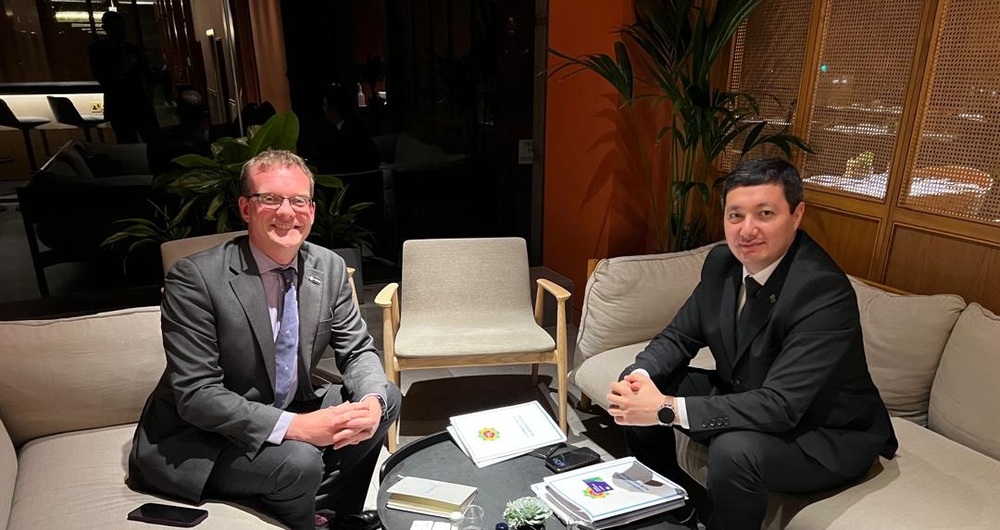
London, February 25, 2026 — As part of the working visit of the government delegation of Turkmenistan to the United Kingdom, led by the Deputy Chairman of the Cabinet of Ministers and Minister of Foreign Affairs, Rashid Meredov, a series of meetings was held with leading British universities, quality assurance organizations, and international educational companies. The Turkmen side was represented at these meetings by the Deputy Minister of Education of Turkmenistan, Azat Atayev.
The day's program began with a visit to the Victoria and Albert Museum, one of the world's largest cultural and scientific centers. This visit underscored the significance of the humanitarian dimension in educational cooperation and the historical continuity of academic traditions.
During the visit, negotiations were held with representatives of University College London (Institute of Education), Cambridge, Oxford EMI, Pearson, the Quality Assurance Agency for Higher Education (QAA), as well as experts in international schools and global educational partnerships.
Systemic Modernization of Higher Education
At the meeting with representatives of University College London, discussions focused on improving the management of the education system based on evidence-based policy principles, developing analytical tools for strategic planning, and training senior management personnel. Special attention was paid to establishing mechanisms for evaluating the effectiveness of educational reforms and aligning curricula with labor market demands.
Cooperation in School Education
During the working meeting with Cambridge representatives, the parties examined in detail the issues of methodological support and the development of a process-based quality assurance system for a flagship British-style international school. The discussions covered approaches to curriculum development, balancing mandatory and elective components, managing study loads, subject trajectory logic, and expected learning outcomes. Key pedagogical parameters were also addressed, including lesson planning, modern educational approaches, formative and summative assessment, and adherence to principles of academic integrity.
Furthermore, the parties discussed a model for teacher training and support, including competency requirements, professional development, mentoring, subject associations, regular lesson observations, and professional feedback. The meeting also covered admission procedures with transparent criteria and appeal mechanisms, as well as internal and external quality control tools, including self-evaluation procedures, academic reporting, performance data analysis, and independent assessment to inform educational decisions and management processes. Following the meeting, both sides confirmed their interest in continuing constructive dialogue and further elaborating on these areas of cooperation.
Development of English-Medium Instruction (EMI)
In a meeting with Oxford EMI, the parties discussed professional development programs for teachers based on the English-Medium Instruction model. They considered the implementation of a pilot project, followed by an evaluation of results and potential scaling upon achieving measurable performance indicators.
International Certification and Examination Infrastructure
Negotiations at Pearson headquarters were dedicated to developing a modern international certification system and establishing examination centers in Turkmenistan. The launch of Certiport and Pearson VUE sectors was discussed, along with the possibility of introducing British qualifications in the school segment. The parties agreed to prepare specific proposals detailing technical requirements and implementation timelines.
International Accreditation and Quality Culture
With QAA representatives, the discussion focused on ESG standards and their adaptation to the national context, the sequence of accreditation procedures, documentation requirements, the evidence base, and monitoring systems for educational programs. They also touched upon learning outcome assessment and academic governance. The parties discussed capacity-building programs for university leaders and staff, including a series of thematic webinars and consultative support during the pre-accreditation phase.
Following the meeting, the sides confirmed their readiness to move to the practical phase of cooperation, which includes the preparation of a written proposal by the QAA, an introductory online session, and the formation of a joint coordination mechanism for further work.
Studying the Wellington International Schools Model (International Schools Track)
During a separate meeting with Mark Labovitch, an expert on international schools and global partnerships, the parties discussed modern models of British-type international schools, including governance architecture, academic standards, and mechanisms for ensuring sustainable quality. Primary focus was placed on methodological and institutional aspects: school management structure, the distribution of academic and administrative responsibilities, the model of interaction with an international educational brand, and principles of long-term quality support.
The meeting also reviewed academic policy parameters, including the formulation of an educational mission, curriculum requirements, student achievement assessment systems, internal monitoring mechanisms, and regular external audits for compliance with international standards. Additionally, approaches to the recruitment, certification, and professional development of teachers, as well as the role of academic leadership in ensuring stable educational results, were discussed.
The working visit confirmed the steady progress of educational cooperation between Turkmenistan and the United Kingdom, emphasizing its focus on achieving concrete, measurable results within the framework of the long-term strategy for national education modernization.