
of the Innovation Information Center
of the Ministry of Education of Turkmenistan
of the Innovation Information Center
of the Ministry of Education of Turkmenistan
Independent Neutral Turkmenistan - the
homeland of purposeful winged horses



News
Turkmenistan Youth Delegation in India: A Meeting of Cultures and Friendship
124
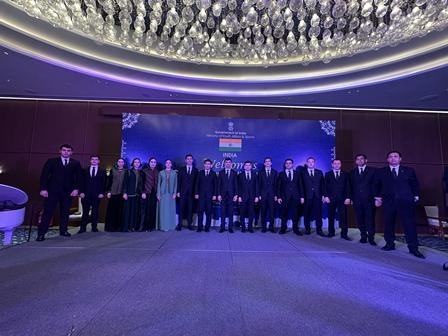
In the era of the Renaissance of the new epoch of a strong state, under the leadership of the Honorable President, our country’s foreign policy places great importance on developing friendly relations with countries around the world, strengthening international cooperation, and expanding youth diplomacy. In recent years, our country’s cooperation with India, which holds leading positions globally in economic indicators, has reached a qualitatively new level. Bilateral relations, based on traditions of friendship, good-neighborliness, and mutual support that date back to ancient times, are now being enriched with new meaning. In this context, from March 24 to April 2, 2026, an international familiarization program called “Tech, Entertainment and Culture” was held in the Republic of India, with the participation of representatives from Central Asian countries.
The delegation, consisting of young representatives working in various sectors of Turkmenistan, actively participated in this international program, including Enejan Babayeva, a lecturer at the Yagshygeldi Kakayev International Oil and Gas University. The main goal of the program was to promote international exchange of experience within the framework of the next stage of youth delegation interaction, strengthen cultural ties, and develop cooperation among representatives of different countries. During the visit, the participants visited India’s major cities — Mumbai, Goa, and New Delhi — where they became thoroughly acquainted with the country’s scientific, cultural, and historical heritage, as well as its modern development trends.
In Mumbai, during an organized visit to one of the world-renowned universities — the Indian Institute of Technology Bombay (IIT Bombay) — participants received detailed information about modern technologies, scientific research, innovative projects, and initiatives supporting young scientists. As part of the program, the participants also visited Mumbai’s historical and cultural landmarks. Among them, the Gateway of India, the Elephanta Caves, and the Chhatrapati Shivaji Maharaj Museum made a particularly strong impression. The examples of ancient Indian architecture and the rich cultural heritage aroused great interest among the participants.
During the events in Goa, the participants visited world-famous monuments of high historical and cultural significance, such as the Basilica of Bom Jesus and the Sé Cathedral. Additionally, at the National Institute of Oceanography, they were introduced to scientific research conducted in the fields of oceanography, marine biology, and climate studies.
The final stage of the visit took place in New Delhi, where the participants attended meetings with representatives of the relevant Indian authorities on youth policy. They also had the opportunity to explore the capital’s historical landmarks, including the Red Fort, Qutub Minar, the National Museum, and Raj Ghat. The international program held in the Republic of India played an important role in strengthening friendly relations among representatives of different countries, promoting the exchange of experience, and advancing international cooperation.
Yagshygeldi Kakayev International Oil and Gas University