
of the Innovation Information Center
of the Ministry of Education of Turkmenistan
of the Innovation Information Center
of the Ministry of Education of Turkmenistan
Independent Neutral Turkmenistan - the
homeland of purposeful winged horses



News
STUDENTS OF THE OGUZ HAN ENGINEERING AND TECHNOLOGY UNIVERSITY OF TURKMENISTAN ACHIEVED HIGH RESULTS IN AN INTERNATIONAL COMPETITION
941
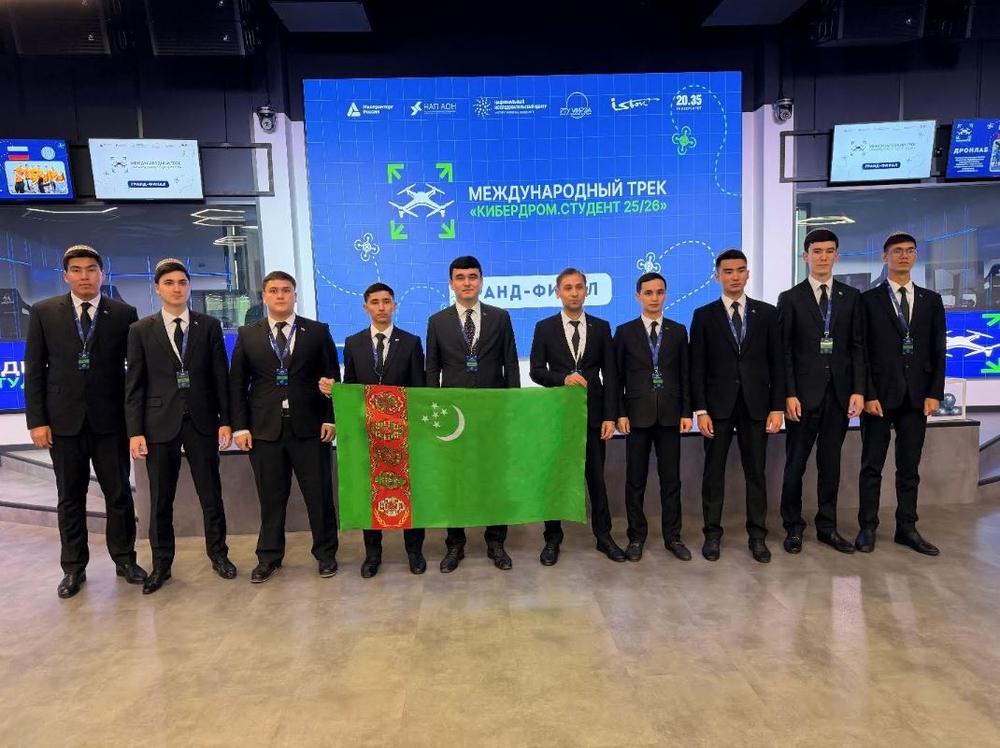
MOSCOW, 2026. – The international competition titled "Specialists for the Digital System: Creating Final Design and Construction Solutions in a Cyber-Arena Format," organized by the Russian Federation and held among the member states of the Commonwealth of Independent States (CIS), has come to an end. In this prestigious competition, which had been ongoing since September 2025, students from the Faculty of Cyber-Physical Systems at the Oguz Han Engineering and Technology University of Turkmenistan returned to our country with great success.
Digital System Engineers are Emerging
The competition was held across three categories in total, and Turkmen students competed in the "Кибердром. Студент" (Cyberdrom. Student) track. Out of 4,278 total participants, 57 selected teams represented six nations (Turkmenistan, the Russian Federation, Belarus, Uzbekistan, Kyrgyzstan, and Kazakhstan). The Turkmenistan team consisted of eight specialists—including programmers, engineers, and technicians—as well as one organizer and one coach.
Having successfully passed the learning and testing phases, the students fulfilled complex requirements in controlling cyber-physical structures on a simulator and assembling them manually. The students demonstrated exceptional skill, particularly in operating flying cyber-physical devices in "acro" mode—executing high-level acrobatic maneuvers.
Semifinal and Simulator Success
In the quarterfinal stage called "Zarnisa," teams competed using ground and airborne cyber-physical devices controlled remotely via a 50–100 Mbps internet connection. The team from the Oguz Han Engineering and Technology University of Turkmenistan earned 4th place among the 57 competing teams.
In the supplementary stage called "Сборка.СИМ" (Assembly of Personal Mobility Devices—this Russian phrase usually refers to the assembly phase of small-scale systems designed for a single person, such as scooters, quadcopters, or other cyber-physical devices that facilitate individual mobility), the Turkmen students achieved a record-breaking result. They completely assembled a flying cyber-physical device consisting of 35 separate parts in just 10 minutes, securing first place with an average score of 97.3 points. In this stage, four students earned a flawless score of 100 points, driving the team's overall ranking even higher.
Semifinal Tests and Python Programming
In the stage leading up to the Grand Final, students were required to design a software algorithm using the Python programming language to automatically control 4 flying and 2 ground-based cyber-physical devices. Utilizing this software, which was written during a 4-hour live broadcast, the cyber-physical devices successfully transported 16 payloads to designated points completely automatically. As a result of these outstanding achievements, the organizing party—the Russian Federation—fully covered all expenses for the Turkmen team and officially invited them to the Grand Final stage to be held in Moscow.
Grand Final: A Massive Victory in the Russian Federation
The Grand Final—the most thrilling and final stage of the competition—took place between May 11 and 16, 2026. Selected from among 57 higher education institutions, the Turkmen students distinguished themselves among the eight powerful teams that reached the finals with the following results:
Simulator Competition: Kerim Nazarov, a 3rd-year student specializing in "Electronics and Nanoelectronics" at the Faculty of Cyber-Physical Systems of the Oguz Han Engineering and Technology University of Turkmenistan and the team captain, claimed first place among 64 participants with a time of 1 minute and 26 seconds..
Team Result: Based on the overall standings of the four contests held on the second day of the two-day competition, the "Oguz Wings" team from the Oguz Han Engineering and Technology University of Turkmenistan earned second place in the general ranking.
Special Nomination:: For demonstrating high speed and agility in the "Кибердоставка" (delivering designated payloads to specified distances in the shortest time) and "Гонка БЭК-ов" (race of unmanned cyber-physical devices) stages, the team was awarded the "Мультироторный маневр" trophy (the cup for the team that controlled multi-rotor cyber-physical structures with the most agility, speed, and accuracy) along with a certificate of honor.
Additionally, within the framework of their engineering projects, the students successfully designed and constructed unmanned cyber-physical systems (known as BEC in Russian) capable of operating both on water and on land.
This international success has become yet another proof that the education provided in higher education institutions of Turkmenistan in the fields of digital and cyber-physical systems aligns with global standards.
Oguz Han Engineering and Technology University of Turkmenistan