
TEXTBOOK "GEOMETRY" FOR 11 TH GRADE OF GENERAL SECONDARY SCHOOLS WAS PUBLISHED
In the period of the Revival of the New Era of the Powerful State, thanks to the tireless efforts of our esteemed President, Arkadagly Hero Serdar who successfully continues the undertakings of Hero Arkadag, the work on modernizing the education system in our country is gaining wide scope and continues to expand. As a result of fruitful work in this area, the events are consistently and successfully implemented. As part of these transformations, special attention is paid to updating educational materials, which contributes to the deep development of fundamental disciplines.
Thus, in the geometry course studied in general secondary schools, two key sections are distinguished: "Planimetry" and "Stereometry". The section of planimetry studies geometric shapes and their properties on a plane, while stereometry, in turn, considers similar objects in space. This division ensures the systematic development of spatial thinking among students.
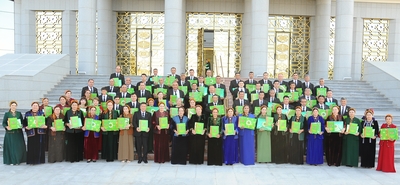
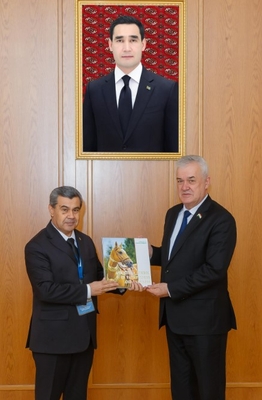
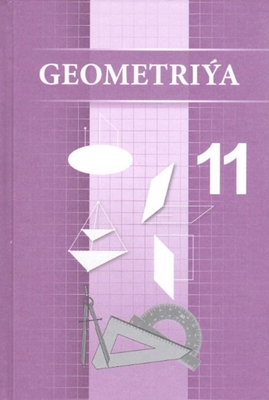
Recently, a textbook "Geometry" was published for the XI grades of secondary schools in our country (authors: G. Shadurdyev, H. Geldiev, Ya. Abaev, A. Ovezov, J. Toraev – A.: Turkmen State Publishing Service, 2025). As for the content of the textbook, it consists of four chapters, each of which consistently reveals complex topics of stereometry. Thus, the structure of the textbook is logically constructed to facilitate the understanding and application of geometric concepts.
Chapter I, devoted to the axioms of stereometry and their consequences, includes the axioms of stereometry, their consequences, relevant exercises and additional tasks. This provides a solid foundation for further study.
Chapter II, entitled "Parallelism of straight lines and planes", covers the mutual arrangement of straight lines in space, the mutual arrangement of straight lines and planes, the mutual arrangement of two planes, the sign of parallelism of two planes, properties of parallel planes, parallel design and its properties, topics on the representation of spatial shapes on a plane, as well as exercises and additional tasks. In addition, this chapter promotes the development of spatial object visualization skills.
Chapter III, "The perpendicularity of straight lines and planes in space," discusses in detail the concepts of the perpendicularity of straight lines and planes, perpendicular and inclined to the plane, the angle between the straight line and the plane, the dihedral angle, the perpendicularity of planes, the feature of the perpendicularity of planes, the area of the orthogonal projection of a polygon; exercises and additional tasks are also posted here. This allows students to deeply grasp the principles of spatial geometry.
Finally, Chapter IV, Cartesian coordinates and vectors in space, introduces topics such as the concept of a vector in space, addition and subtraction of vectors, multiplication of a vector by a number, coplanar vectors, point coordinates and vector coordinates, the dot product of vectors, the equation of a sphere and a plane, the formula for the distance from a point to a plane, as well as exercises and additional tasks to consolidate knowledge. Thus, the textbook ends with a comprehensive analysis of vector and coordinate methods.
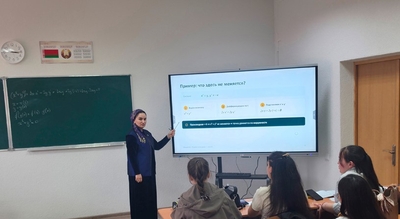
The tasks in the exercises are built from simple to complex, which ensures the gradual development of skills. The examples and tasks given are detailed enough for independent work, and the correct answers posted at the end of the textbook allow for self-verification. As a result, this textbook not only reflects modern achievements in mathematics, but also contributes to the formation of a patriotic attitude towards national education among students.
The Department of Textbook Preparation and Publishing,
Ministry of Education of Turkmenistan