
Connectivity starts with people: from a national roundtable to the regional DARYA agenda
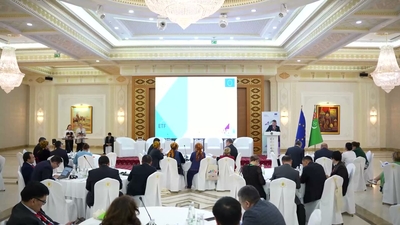
Ashgabat, 14 October 2026. A series of meetings with European partners on human capital development has concluded in Ashgabat. Taking part were the Director of the European Training Foundation (ETF), Pilvi Torsti; the EU Special Representative for Central Asia, Eduards Stiprais; the Ambassador of the European Union to Turkmenistan, Luc Devigne; and the Ambassador of Turkmenistan to the Kingdom of Belgium and Head of the Mission of Turkmenistan to the EU, Sapar Palvanov. Over three days the discussion moved from Turkmenistan's national priorities to a shared regional agenda. This reflects the consistent policy of the President of Turkmenistan, Serdar Berdimuhamedov, in which education underpins economic development and international cooperation.
National level: a shared understanding at home
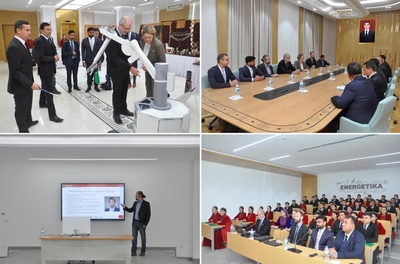
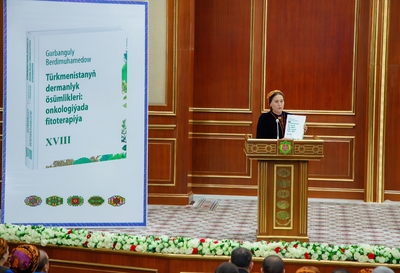
On 12 October the Turkmen State Institute of Architecture and Construction hosted the high-level roundtable "Turkmenistan – European Training Foundation: Human Capital as the Foundation of Connectivity", organised by the Ministry of Education of Turkmenistan and the ETF. Around one table sat the Ministry of Education; the transport sector (the Ministry of Railway Transport, the State Service of Maritime and River Transport, the Ministry of Automobile Transport and the Türkmenhowaýollary service); the Ministry of Finance and Economy; the Ministry of Labour and Social Protection of Population; and universities and vocational schools.

Deputy Minister of Education Azat Atayev presented the roundtable's concept note:
The main result of the national stage was a shared understanding and consensus vision across government that human capital drives the development of the transport and logistics sector. These national tasks were then aligned with European Union approaches: Global Gateway, Team Europe and the next EU budget cycle for 2028–2034.

Regional level: a shared vision for the corridor
On 13–14 October Ashgabat hosted the fifth meeting of the DARYA High-Level Group, "Building the skills dimension of the Trans-Caspian Transport Corridor". Representatives of the same institutions that sat at the roundtable took part in the regional discussion. This allowed the agreed national position to be carried to the regional level. The State Service of Maritime and River Transport and the Ministry of Railway Transport shared how the sector trains its workforce, and the Ministry of Labour and Social Protection of Population presented the labour-market perspective.

A common understanding and a consensus vision took shape at regional level. Connectivity of the corridor means, above all, connectivity of the skills and competences of the specialists who run corridors today and will run them tomorrow. Given rapid technological progress, education systems must develop ahead of demand. And connectivity in training starts with aligning approaches and methods of teaching and learning.

In the session on the Regional Skills Roadmap, Turkmenistan presented the joint position of the Ministry of Education, the Ministry of Labour and Social Protection of Population and the TULM association. Turkmenistan supported voluntary participation by countries and transport and logistics as the first sector of application. It proposed three practical actions: multi-country occupational profiles starting with a logistics analyst, a comparable analysis of skills needs, and joint modular programmes with training for teachers. These would be carried by a light expert network.
Fabienne Van Den Eede, Deputy Head of Unit for Central Asia and Afghanistan at the European Commission's Directorate-General for International Partnerships (DG INTPA), noted Turkmenistan's professional approach: the country's proposals are built on a clear understanding of how decisions are made.
The strategic basis of Turkmenistan's proposals
Turkmenistan drew its priority tasks for future projects from national strategic documents: the Strategy for the Development of Higher Professional Education in Turkmenistan for 2026–2052 and the Action Plan for its implementation for 2026–2030, and the Concept for the Development of the Labour Market to 2030 with its implementation plan, approved by the President of Turkmenistan. The country's proposals therefore rest on decisions already taken at national level, not on one-off initiatives.

The bilateral agenda: skills for the economy
In bilateral meetings Turkmenistan set out priority areas of cooperation on skills for the needs of the economy. They follow the positions set out by President Serdar Berdimuhamedov at the first Central Asia – European Union Summit in Samarkand on 4 April 2025. There the Head of State proposed considering a joint project in vocational education, stressed the importance of training highly qualified technical specialists and gave a key role to the Trans-Caspian route. The "Skills Bridge for Global Gateway" proposal builds on these decisions: it focuses on the technical and vocational skills needed for Global Gateway projects.

Key takeaways
Participants expressed deep gratitude to the President of Turkmenistan, Serdar Berdimuhamedov, for creating the conditions for the meetings to be held at a high organisational level. The week confirmed once again that Turkmenistan's course on human capital development and open international cooperation delivers practical results and draws the interest of partners.